

Understanding the Court Ruling on the MRC
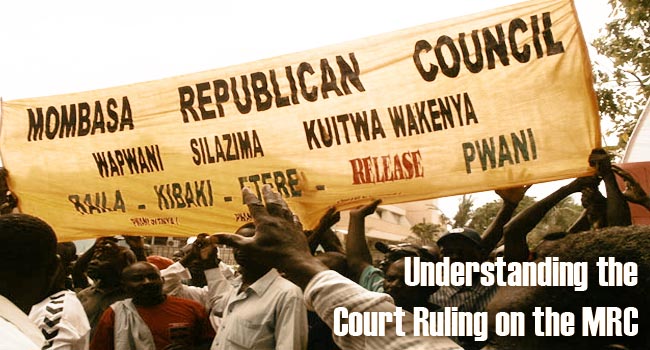
Two years ago, the Minister of State for Provincial Administration and Internal Security, the late George Saitoti, published a Gazette Notice (No. 12585) which stated that the Mombasa Republican Council (MRC) is an organized criminal group that was unconstitutional. Despite all the controversy surrounding them, the MRC filed a petition to the court seeking determination on whether or not they should be considered unconstitutional.
Subsequently, after a careful assessment of the facts at hand and the position of the law, the High Court has now lifted that ban on the Mombasa Republican Council, effectively giving them license to pursue their agenda - as long as they remained within the confines of the law.
The Articles in the Court Ruling
The Court put into consideration various provisions in The Constitution in arriving at this decision.
Article 36 (1), which expresses the freedom of association, was cited by the Court. It states as follows:
"Every person has the right to freedom of association which includes the right to form, join or participate in the activities of an association of any kind."
Article 37 on assembly:
"Every person has the right, peaceably and unarmed to assemble, to demonstrate, to picket, and to present petitions to public authorities."
Article 38 (1) on political rights:
"Every citizen is free to make political choice, which includes the right:
- to form, or participate in forming a political party.
- to participate in the activities of, or recruit members for, a political party; or
- to campaign for a political party or cause."
Article 24 (1) provides as follows:
"A right or fundamental freedom in the Bill of Rights shall not be limited except by law, and then only to the extent that the limitation is reasonable and justifiable in an open and democratic society based on human dignity,
Equality and freedom, taking into account all relevant factors, including –
- the nature of the right or fundamental freedom;
- the importance of the purpose of the limitation;
- the nature and extent of the limitation;
- the need to ensure that the enjoyment of rights and fundamental freedoms by any individual does not prejudice the rights and fundamental freedoms of others; and
- the relation between the limitation and its purpose and whether there are less restrictive means to achieve the purpose."
The court pronounced that the evidence was insufficient to prove MRC's connection to violent crimes and added the group may agitate its agenda through political and legal means. Contrary to their expectations, MRC's chants, slogans and "agitation for secession" might constitute hate speech, propaganda for war, incitement to violence or advocacy for hatred, which is "unconstitutional and criminal", as stated by the Court.
Secession
The group has been warned against demanding secession for the coastal strip or dismembering the country or even inciting hatred. The Court ruled that according to Article 5 of the Constitution, more territory can be added or included to what currently comprises Kenya and that the Article does not suggest that Kenya can lose or cede any part of its territory.
Article 5 of the Constitution provides:
"Kenya consists of a territory and territorial waters comprising Kenya on the effective date, and any other additional territory and territorial waters, as defined by an Act of Parliament."
The Ethiopian Constitution for example expressly provides for secession and thus envisages secession by declaring this under Article 39 of their Constitution:
"Every nation, nationality and people in Ethiopia has an unconditional right to self determination, including the right to secession."
But in Kenya, the right to secession can only be achieved by an amendment to section 5 of the Constitution. An amendment to the Constitution would require a referendum.
Despite this ruling, MRC still remains adamant in its push for secession.


